

Creating A Poster In Indesign
Creating a research poster in InDesign
This section of Creating Research Posters will cover creating a poster in Adobe InDesign, including creating a new file, adding images and text, and exporting the final version in a print-ready format.
NOTE: This section of the course assumes that you're familiar with recent versions of Adobe InDesign. If you haven't worked with InDesign before, it's recommended that you view the video Adobe Creative Cloud: Interface Basics before starting your poster, as it provides an overview of InDesign's interface and where to find the various tools and panels used.You may also want to review the content in the course InDesign: The Basics before building your poster.
Things to note about creating a poster in InDesign
InDesign is a powerful page layout program, but it can be overwhelming for new users. As InDesign is primarily geared towards making print layouts, it offers robust options for laying out text and images, as well as styling text used in a document. If you have some experience creating layouts in InDesign, creating a poster involves using the same tools you may have used for making smaller documents, such as flyers or newsletters. Following are some things you should be aware of when creating a poster in InDesign:
- Working with images can be a little tricky, as it involves working with the image and its frame, so you'll need to be careful with how you select images when moving them around on the page.
- InDesign can import text files of all types, including Microsoft Word documents - however, if you format the appearance of text in your Word document, InDesign may import that formatting as well.
- InDesign allows for designating how many columns of text you want in your poster during the new document creation process, which eliminates the need to make individual text frames for each column.
- InDesign also has the ability to set a specific page margin during the new document creation process, providing the needed space between the content and the poster's edge and ensuringnone of the poster's content accidentally gets cut off. (A margin of 1/2 inch is recommended.)
Setting up the poster file
The first step in the poster creation process is to create the poster file, and ensure that the page is the correct size for your poster.
Step 1. Open InDesign.
Step 2. To create a new file, in the Menu bar,
Click File, Point to New, Click Document
Step 3. To indicate you want to create a print document, at the top of the New Document dialog box,
Click Print
Step 4. To change the unit of measurement used in the new document, in the Units dropdown next to the Width field,
Click , Click Inches
Step 5.To set the width and height of your poster, in the Width and Height fields,
type in the desired width and height for your poster
Step 6.To change the amount of columns on the page, in the Columns field,
enter the desired number of columns
At this point, you can adjust the margins for your poster if needed. InDesign's default margin setting is 1/2 inch, but this can be changed if need be.
Step 7. To change the margin spacing for the poster, under the Columns section
Click Margins, adjust the margin size as need be
Step 8. To finish creating the new file,
Click
The last two steps involve setting up the workspace to make it easier to align items on the page — this involves turning on the document grid and rulers.
Step 9. To turn on the grid, in the menu bar,
Click View, Point to Grids and Guides, Click Show Document Grid
Step 10. If necessary, to display the rulers,
Click View, Click Show Rulers
Adding content to the poster
Adding the content for the poster will be split into two sections: adding text and adding images.
Adding Text
As mentioned previously, InDesign can import Word documents, as well as plain text documents, and place the text into your poster. Importing text to a poster makes use of the Place command in InDesign.
The following video demonstrates how to add text to a poster in InDesign, and the process demonstrated in the video is outlined in steps following the video.
Step 1. To add text to the poster, in the Menu bar,
Click File, Click Place
Step 2. To select the text to add to the poster, in the Place dialog box,
navigate to the file you want to place, then Double-click the file to open it
NOTE: If you are importing a Word document that contains text formatting, and want to control how the text is imported, click theShow Import Options checkbox at the bottom of the Place dialog box before opening your file. This will display the Import Options dialog box, which will allow you to choose how your text is imported into InDesign.
Your cursor will have a thumbnail next to it indicating that it is ready to place text. There are two ways we can add text to the poster: we can have it automatically flow through all columns in the poster, or we can manually place text into each column until we run out of text.
Step 1. To flow the text through all the columns in your poster,
Press and hold the Shift key,Click at the top of the first column
The text will automatically fill all the columns on the poster.
Step 1. To add text to the first column on the page,
Click at the top of the first column
Step 2. To add text to the next column, at the bottom of the first column of text,
Click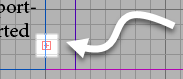 , Click top of next column
Step 3. Repeat step 2 until all text has been placed.
To change the appearance of your text, you'll want to use a combination of the Type tool, located in the Tools panel on the left side of the screen, and the Control Panel, which is located across the top of the screen. When the Type tool is selected, the Control Panel will display options for formatting the display of text, such as fonts, font size, and spacing, as shown in the following image:

There may be different options visible, depending on your screen size. You can easily switch between changing the appearance of text and paragraphs by clicking on the two icons on the far left of the Control Panel. For more information on formatting the appearance of text, view the Adobe Help article on formatting text in InDesign.
NOTE: If the text you placed in your document only took up one column before the text is styled, you may need to manually flow the text to other columns. To manually flow the text after it has been placed, follow the instructions inMethod two: Manually place text in each column.
Adding Images
Adding images to a poster in InDesign is also done using the Place command. Remember, when adding images to your poster, don't enlarge them after they've been placed into your poster — if they appear too small once added to your poster, you may want to check and make sure that they're an appropriate size and resolution for your poster. For more information, read Changing your Image's Resolution in theGathering High Quality Images section of this course.
The following video demonstrates how to add images to a poster in InDesign, and the process demonstrated in the video is outlined in steps following the video.
Step 1.To add an image to the poster, in the Menu bar,
Click File, Click Place
Step 2.To select the image to add to the poster, in the Place dialog box,
navigate to the file you want to place, Double-click the file to open it
NOTE: If you clicked theShow Import Options checkbox when importing text, the Show Import Options dialog box may appear at this step.
At this point, InDesign will display a thumbnail of the image next to your cursor.
Step 3.To place the image,
Click the location where you want to place the image
The image will appear on the page.
Wrapping text around an image
Once images are added to your poster, you'll want to wrap your poster's text around them. This can be done using the Text Wrap panel.
Step 1.To select the image you want to wrap text around, in the Tools panel,
Click  , Click the image
Step 2.To open the Text Wrap panel, in the Menu bar,
Click Window, Click Text Wrap
Step 3.To add a text wrap to an image, in the Text Wrap panel,
Click
Step 4.To adjust the space between the image and the text, underneath the text wrap option buttons,
Click or
or to adjust the amount of offset spacing
For more information on working with the Text Wrap panel in InDesign, view the Adobe Help article on wrapping text around images in InDesign.
Preparing the poster for printing
Once you've completed your poster, you'll want to make sure that it's saved as a PDF. This ensures that your poster will look exactly the way you want it to when it's printed, and will package all of your images, fonts, and text into one file that can be printed on any computer.
Step 1.To start the process of exporting the poster as a PDF, in the Menu bar,
Click File, Click Export...
Step 2.In the File Name field, if necessary, type in the name for the file.
Step 3.To select PDF as the file export type, in the Export dialog box,
Click the file type dropdown,Click PDF (Print)
Step 4.To continue the export process, at the bottom right corner of the Export dialog box,
Click
Step 5.To ensure the PDF is saved at the highest quality possible, in the Save Adobe PDF Options window,
Click the preset dropdown, Click High Quality Print
Step 6.To finish exporting the poster as a PDF,
Click
Your poster will be saved as a PDF, and depending on your settings, may open automatically in the default PDF viewer for your computer.
Creating A Poster In Indesign
Source: https://ittrainingcontent.iu.edu/training/crpos/files/uc/create-poster-indesign.html
Posted by: monroebleenter.blogspot.com
0 Response to "Creating A Poster In Indesign"
Post a Comment